Click above to see exactly who is on your ballot
YOUR ROAD TO
November 3
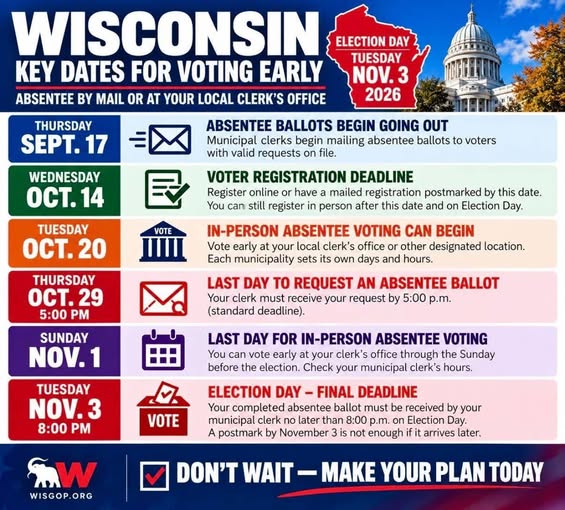
You can register at the polls.
CHECK YOUR REGISTRATION • FIND YOUR POLLING PLACE • REQUEST AN ABSENTEE BALLOT
MyVote.WI.gov
🏛️ Statewide Offices
The following candidates are recommended conservative candidates
To see the candidate’s Web Pages click on their name
Candidate for Governor
Candidates for Lt. Governor:
Secretary of State
Assembly Candidates
40th Assembly District: Julie Helmer 41st Assembly District: Tony Kurtz
Wisconsin State Treasurer
WIsconsin State Attorney General
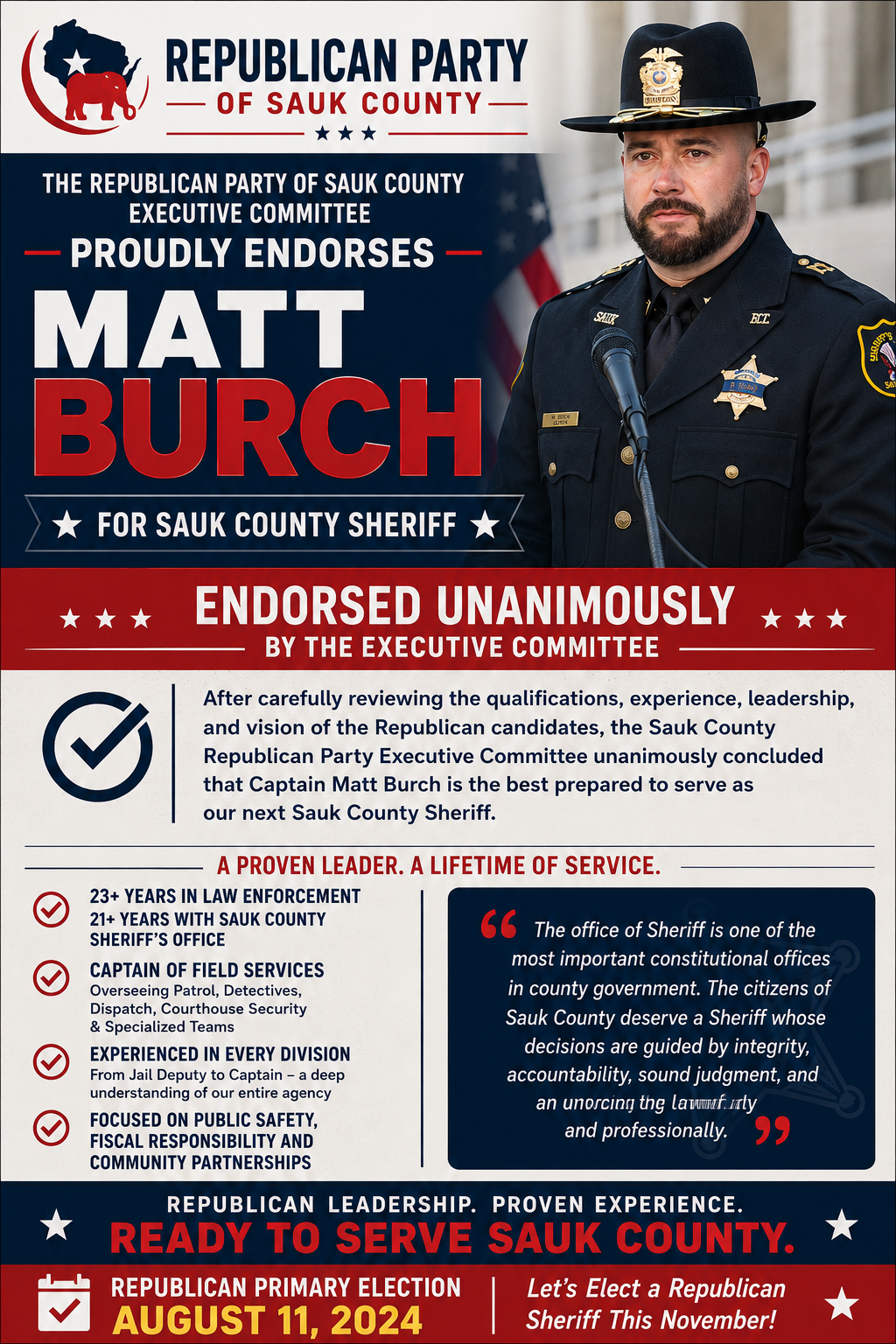
Sauk County Sheriff
Sauk County Coroner
Here is an explanation of the 3 Constitutional questions that was created by Senator Howard Marklein
Three Constitutional Questions on Your November Ballot
When you go to vote this fall, three constitutional questions will appear on your ballot. Each one has been passed by the Legislature in two consecutive sessions and will now go before the voters to decide whether or not they will be added to the Wisconsin Constitution.
Prohibiting a Governor from Using the Partial Veto to Increase a Tax or Fee
QUESTION 1: “Partial veto. Shall section 10 (1) (c) of article V of the constitution be amended to prohibit the governor, in exercising his or her partial veto authority, from creating or increasing or authorizing the creation or increase of any tax or fee?”
The Wisconsin Governor has one of the strongest veto pens in the entire country. Governor Evers used this veto power in 2023 to raise property taxes for the next 400 years. This constitutional amendment seeks to prevent future governors from increasing taxes and fees on their own.
YES vote – Prohibit the governor from using the partial veto to increase a fee or a tax without a vote by the full legislature.
NO vote – Maintain the status quo, allowing future governors to act independently of the legislature to increase your taxes.
Prohibiting the Government from Closing Places of Worship During States of Emergency
QUESTION 2: “Freedom to gather in places of worship during an emergency. Shall section 18 of article I of the constitution, which deals with religious liberty, be amended to prohibit the state or a political subdivision of the state from ordering the closure of, or forbidding gatherings in, places of worship in response to a state of emergency, including a public health emergency?”
During the COVID-19 pandemic, churches and other places of worship were forced to shut down due to strict orders from state and local governments. Businesses deemed “essential” were allowed to stay open, but places of worship were shuttered. This constitutional amendment seeks to prohibit the government from shutting down places of worship during a state of emergency, including a public health emergency.
YES vote – Prohibit governments from closing or forbidding gatherings in places of worship in response to a state of emergency.
NO vote – Allow governments to prohibit gatherings in places of worship during a state of emergency.
Prohibit Government Discrimination or Preferential Treatment Based on Race, Sex, Color, Ethnicity, or National Origin
QUESTION 3: “Governmental entity discrimination prohibited. Shall section 27 of article I of the constitution be created to prohibit governmental entities in the state from discriminating against, or granting preferential treatment to, any individual or group on the basis of race, sex, color, ethnicity, or national origin in public employment, public education, public contracting, or public administration?”
Wisconsin currently has a number of state laws, agency programs, and areas of the state procurement system that are, at least partially, based on race, sex, color, ethnicity, or national origin. This constitutional amendment seeks to restore merit, fairness, and equality to all governmental entities in Wisconsin by prohibiting discriminating against, or granting preferential treatment to, any individual or group on the basis of race, sex, color, ethnicity, or national origin in public employment, public education, public contracting, or public administration.
YES vote – Prohibit the government from discriminating or granting preferential treatment based on race, sex, color, ethnicity, or national origin.
NO vote – Allow race-based programs, processes, and laws to continue in Wisconsin.
These three constitutional questions will be on your ballot for the November 3 election. Make sure you take the time to fully understand these questions before heading to vote!
✅ Find the Candidates on Your Ballot
But First — Save Wisconsin — Vote the Entire Ballot
Many conservatives showed up in 2024 to vote for Donald Trump — and that was important.
But in Wisconsin, we have a major problem that many voters still do not realize:
Wisconsin does NOT have straight-ticket voting.
That means voting for President does NOT automatically vote for Republicans down ballot.
You must continue filling out the ENTIRE ballot — all the way down through:
• State Supreme Court
• State Assembly
• State Senate
• County offices
• School boards
• Local referendums
Too many conservatives stopped after voting for Trump, and as a result Republicans lost critical state and local races.
The Left understands this. They vote every race, every office, every time.
If conservatives want to save Wisconsin, we cannot leave half the ballot blank.
A presidential victory means very little if liberal judges, liberal school boards, and liberal state officials still control Wisconsin afterward.
Complete the ballot.
Vote the entire ballot.
Encourage your friends and family to do the same.
That is how we win Wisconsin back.
MyVote Wisconsin – What’s On My Ballot
📍 Official Election Information
For official election dates, filings, and local updates, please visit:
Sauk County Clerk
Wisconsin Elections Commission
🗓️ Reminder
Please make a plan to vote and encourage friends and neighbors to participate in the August Primary Election.
Your local vote matters.
This information is provided for informational purposes and reflects recommendations from the Republican Party of Sauk County

